Categories
New Blog
Feature Stacking and Product Differentiation: Practical Judgement from an ODM Manufacturer
In today’s highly mature consumer
electronics and small appliance markets, product homogenization has become a
common reality for global brands and sourcing teams. Whether in North America,
Europe, or markets dominated by cross-border e-commerce and channel brands,
convergence in industrial design, core feature sets, and price positioning is
increasingly evident. Across many categories, products from different brands
show limited differentiation in baseline performance and technical approach,
with competition gradually shifting toward the number of features and parameter
combinations offered.
Against this backdrop, “achieving
differentiation by adding more features” has become a widely adopted strategy.
Features are often seen as the most visible and easiest differentiators to
explain and demonstrate at the sales level, leading to continuous additions
during product planning. However, based on long-term involvement in ODM/OEM
mass production projects, feature stacking is more often a response to
competitive pressure than the result of a structured assessment of user value.
In multiple ODM/OEM programs where our clients have achieved sustained, stable
shipment volumes in core markets, we have repeatedly observed that a higher
number of features does not inherently translate into long-term competitive
advantage. As supply chain transparency increases, compliance requirements
tighten, and cost and lead-time constraints become more explicit, it is
necessary to re-examine which features truly support meaningful product
differentiation.
Definition and Common Drivers of Feature
Stacking
In the context of product development,
feature stacking typically refers to continuously adding new functional
modules, usage modes, or technical solutions to a single product platform,
thereby covering more use cases or creating a “richer” set of selling points. This approach is common in both brand-led
development projects and ODM/OEM collaborations, particularly when brands seek
rapid market entry with a first-generation product or benchmark directly
against competitors.
The drivers behind feature stacking
generally come from several sources. First is market pressure—brands often require that their feature lists “do not fall behind competitors.” Second is
sales and channel demand, where the number of features is used to justify
pricing or support channel negotiations. Third is engineering feasibility—when a feature is technically achievable and supported by an
existing solution, it is often easily added to the requirement list. While
these concerns are understandable, it is important to note that such drivers do
not necessarily reflect real user demand, nor are they always positively
correlated with long-term commercial performance.
The Misconception Between Feature Count
and Differentiation
In practical ODM appliance manufacturing
projects, a common misconception is equating “more
features” with “greater
differentiation.” On the surface, a longer
specification sheet may appear to offer stronger market separation. However,
from both a user experience and commercial outcome perspective, differentiation
is better defined by whether a product delivers a more reliable, efficient, or
intuitive solution in key usage scenarios.
When additional features are not aligned
with users’ core tasks, products tend to become more
complex. Longer operation paths, higher learning curves, and increased risk of
misuse often result. During the post-sales phase, these issues typically
translate into higher inquiry rates, increased returns, or negative feedback.
For ODM/OEM manufacturing services focused on scalable delivery, such problems
not only affect the brand's customer experience but also introduce hidden costs
in manufacturing, quality control, and the brand's after-sales support.
Cost and Risk Trade-Offs from a
Manufacturing Perspective
From a manufacturing and supply chain
standpoint, feature stacking is not an abstract concept but a combination of
measurable costs and risks. Each additional hardware or system-level feature
usually leads to a more complex bill of materials (BOM), increased material
management complexity, and longer testing and validation cycles. For electrical
appliances, feature changes may also trigger additional safety, EMC, or energy
efficiency certification requirements. In real OEM projects, we have seen cases
where adding a non-core display feature alone resulted in EMC rework and
retesting, delaying market launch by six weeks and adding tens of thousands of
dollars in certification costs.
During ODM/OEM appliance manufacturing,
functional complexity directly impacts mass production stability. A higher
number of components and assembly steps amplifies yield variability and reduces
flexibility when switching production lines or scaling output. From an ODM/OEM
service perspective, these issues are not always fully apparent during project
initiation but often surface during pilot runs and mass production, placing
sustained pressure on lead times, cost control, and supply chain coordination.
Case Perspective: Feature Trade-Offs in
Fruit and Vegetable Cleaning Appliances
In practice, fruit and vegetable
cleaning machines represent a typical category where feature stacking
issues frequently arise. When targeting North American and European markets,
these products are often expected to integrate multiple layers of functionality
into a single platform to meet the brand buyers' requirements. These features
can generally be grouped into three categories: first, functions related to the
core cleaning mechanism, such as ultrasonic cleaning, bubble water flow, or
other physical assistance methods; second, control and interaction features,
including multiple cleaning programs or digital user interfaces; third,
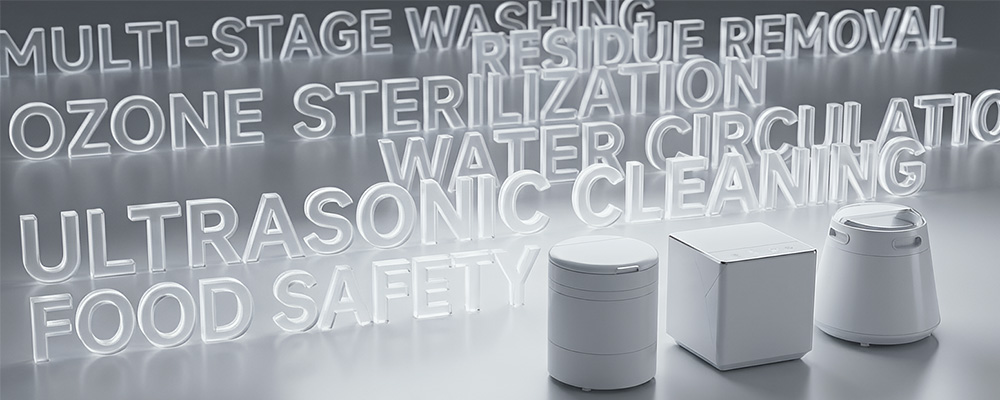
additional experience or smart features, such as water purification,
circulation and filtration systems, connectivity, or app-based control. Across
different markets and user segments, the perceived value of many of these
features varies significantly.
From an ODM/OEM cleaning appliances
manufacturing perspective, none of these features presents fundamental
engineering barriers. However, the weighting between user value, manufacturing
complexity, and long-term commercial return differs substantially across
feature levels. In multiple mass production projects, it has been observed that
certain features directly support users’ core
objectives—such as cleaning performance consistency,
noise control, and overall operational safety—while
others remain largely conceptual or parameter-driven (for example, water
circulation purification, an excessive number of cleaning modes, or
connectivity and remote control functions). Feature stacking not only increases
BOM costs but also adds complexity to water systems, electronic controls, and
structural design, resulting in heavier testing and certification burdens. From
a value-for-money perspective, a more effective approach is often to focus
engineering optimization on the core cleaning mechanism, enhancing the perceptibility
of differentiation where it matters most. Non-core features can then be offered
as higher-tier variants enabled by a platform-based, configurable
architecture (tiered SKUs / optional feature packages) rather than being
fully integrated into the base model.
Design Priorities: Replacing Intuition
with Validation
At the feature decision stage, ODM
manufacturers tend to advocate for validation-driven development rather than
reliance on intuition or market assumptions. Clearly defining core usage
scenarios and mapping each feature directly to those scenarios is critical to
preventing uncontrolled feature expansion. Through prototype testing,
small-batch validation, or proof-of-concept stages, it is possible to identify
early on which features are actually used and which exist only in requirement
documents.
Based on ODM/OEM collaboration experience,
the earlier such validation mechanisms are introduced, the lower the cost of
subsequent engineering changes, certification adjustments, and production
ramp-up. This approach not only helps control development costs but also supports
consistency in post-launch product experience.
Practical Checklist: Executable
Recommendations from an ODM to Brands
In real-world collaboration, ODM
appliance manufacturers typically recommend a more structured feature
evaluation methodology. First, all candidate features should be included in a
feature mapping matrix and assessed across three dimensions: user value,
implementation cost, and contribution to differentiation. Second, apply Value
Engineering logic to decouple high-cost, non-core features from the base
architecture. By adopting a Scalable Design approach, brands can offer tiered
product configurations (SKUs) that target different price points without
burdening the entire production line with unnecessary complexity. Third,
usability and reliability evaluations should be introduced before feature
freeze, preventing added features from undermining the efficiency of core
tasks.
In addition, every feature change should be
evaluated in parallel for its impact on the supply chain, test processes, and
certification pathways, and managed as part of the ODM/OEM manufacturing
agreement and mass production feasibility assessment. This practice helps
establish clearer alignment between commercial objectives and manufacturing
realities.
Decision Guidance for North American and
European Buyers and Brand Owners
For procurement teams, product managers,
and supply chain leaders in North America and Europe, the key question when
evaluating a feature is not whether it appears “advanced,” but whether it is supported by clear user evidence, controllable
manufacturing costs, and a defined supply chain delivery plan. When engaging
with professional ODM appliance manufacturers, requesting engineering impact
assessments and mass production risk explanations for each feature often
provides more value than simply comparing feature counts.
Incorporating feature design into a
long-term product roadmap—rather than stacking
everything into the launch model—also better aligns
with mature market expectations for stability and sustainability.
More features do not inherently result in greater product differentiation. In highly homogenized markets, sustainable differentiation comes from a deep understanding of core user needs, stable and controllable manufacturing systems, and clear management of supply chain risks. As a professional manufacturer focused on ODM/OEM cleaning appliance manufacturing services, the ATYOU Health Tech team tends to layered feature strategies, validation-driven development processes, and mature ODM/OEM manufacturing frameworks to help brands strike a balance between differentiation and mass production. Placing feature design within a verifiable commercial and engineering framework is often far more effective than simply pursuing feature quantity when building long-term competitiveness.
 No. 1-A, Kechuang Center, No. 289 Wengjiao Rd., Haicang Dist., Xiamen, 361000, Fujian, China
 (86)0592-5626338
Subscribe to our newsletter
Our parent company

Xiamen Qiqiangsheng Moulds Co., Ltd.
Copyright © 2012-2026 Xiamen Atyou Health Technology Co., Ltd. All Rights Reserved.

 English
 español