Categories
New Blog
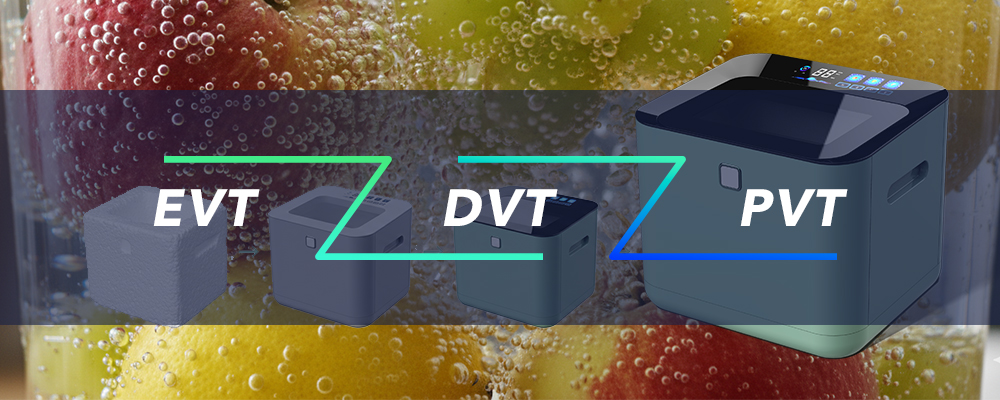
Key Stages You Must Understand in New Product Development: EVT / DVT / PVT
In any customised small appliance or electronic product development project that starts from scratch, the journey from industrial design drafts to final mass production is never a straight, smooth path. Instead, it is a structured process built on multiple rounds of prototype iterations and stringent validation. Whether it is an ODM project or an OEM development from ID to mass production, EVT, DVT and PVT are the three critical milestones that determine product quality, functional stability and manufacturing success. Understanding the objectives and boundaries of these stages not only helps brand owners manage project pace more accurately but also enables both brands and manufacturers to align their communication and resource planning.
EVT (Engineering Validation Test): Engineering Validation Stage
EVT typically takes place after the structural and electronic engineering teams have completed their initial designs, using an engineering prototype as the validation carrier. These prototypes are often closer to “functional samples”; the appearance may not yet be final, but the core objective remains singular: to confirm whether the engineering design and key technical paths are feasible.
For innovative cleaning equipment such as ultrasonic food cleaning and purification machines, EVT often focuses on the feasibility of new technologies — for example: transducer placement, high-frequency amplitude stability, surface detachment efficiency, hydroxyl electrolysis module stability, water chamber flow design, and the thermal/load capability of the power-drive module. As such products involve the collaboration of several subsystems — ultrasonic cleaning, electrolytic purification, chamber structure, and electronic control — engineering teams typically iterate rapidly during EVT to resolve core technical risks before mass-production costs become locked in.
Core objectives of the EVT stage:
• Confirm the feasibility of core functional pathways
• Validate key engineering parameters, such as ultrasonic frequency, power stability, and transducer layout feasibility
• Verify subsystem compatibility (e.g., driver board vs. transducer, ultrasonic system vs. water-electrolysis purification system)
• Identify critical risk points, such as noise spikes, overheating, uneven ultrasound fields, or chamber leakage
• Enable the brand to confirm that functional performance meets expectations, preparing the design for freeze before DVT
This stage is primarily led by the R&D team. The goal is to answer the question “Can it operate?” and to stabilise all engineering logic. Once key functions are closed and stable, the project can progress to the next stage.
DVT (Design Validation Test): Design Validation Stage
DVT evaluates whether the product “meets design intent and real usage scenarios”. Prototypes at this stage are usually produced using hard tooling or near-final moulds. The appearance, structural details, assembly methods, materials, and overall UX are all much closer to the final mass-production unit.
For ultrasonic cleaning products, the focus of DVT is no longer whether the machine operates, but whether it can run safely and stably over time. For an ODM cleaning-device manufacturer, DVT is also a key window for assessing mould accuracy, tolerance accumulation and overall unit-to-unit consistency.
Core objectives of the DVT stage:
• Validate the reliability and durability of the complete design (e.g., chamber fatigue, transducer stability)
• Verify long-term consistency of performance, including purification efficiency, noise, and temperature rise
• Prepare for regulatory, safety and EMC pre-compliance
• Confirm hard-tooling precision and assembly tolerances achieve mass-production levels
• Optimise manufacturing processes in preparation for PVT pilot runs
R&D and quality engineering teams (DQA) jointly lead this phase. After completing small-batch validation and achieving design freeze, the product becomes ready for mass-production validation.
PVT (Production Validation Test): Production Validation Stage
PVT is the final validation phase before mass production. It involves pilot-run builds using the actual production line and official materials to confirm whether the manufacturing system is stable and mature. At this stage, the focus shifts from design validation to production consistency.
For home food cleaner and purifier, which involves precise structures and multiple process parameters, PVT is especially crucial. Minor variations in process conditions or materials can easily result in inconsistent performance during mass production. Therefore, PVT simultaneously validates whether manufacturing processes can replicate performance reliably and whether yield rates meet the target.
Core objectives of the PVT stage:
• Verify that the production line can operate stably and achieve the required throughput
• Close all process parameters, jigs and inspection procedures (e.g., ultrasonic power testing, chamber sealing inspection)
• Ensure defect rates remain controlled and meet mass-production expectations
• Confirm supply-chain stability, especially for key parts such as transducers, electrolysis modules, drivers and sealing components
• Release the line for official mass production (MP)
The key output of this phase is the confirmation that production yield is acceptable and that standard operating procedures (SOPs) are fully established. No further design changes are permitted at this stage. Once PVT results are stable, the product is considered free of systemic manufacturing risks, and pilot units may be shipped as the first production batch.
From Design to Mass Production, No Step Can Be Omitted
The value of EVT / DVT / PVT lies not only in process management but also in eliminating design and manufacturing risks through progressive validation. For brand owners, understanding these stages helps accurately assess development timelines, plan testing resources, establish a common technical language with the factory, and minimise risks such as design defects, yield issues and launch delays.
For electrical appliances that require stable performance and high consistency, three factors are paramount: engineering feasibility, design conformity, and mass-production reproducibility. EVT / DVT / PVT are precisely the core pathways that validate and secure these outcomes.
Whether the product is a cleaning appliance, a health-tech device, or a more complex electronic system, this framework forms the essential methodology for ensuring a successful new product launch.
 No. 1-A, Kechuang Center, No. 289 Wengjiao Rd., Haicang Dist., Xiamen, 361000, Fujian, China
 (86)0592-5626338
Subscribe to our newsletter
Our parent company

Xiamen Qiqiangsheng Moulds Co., Ltd.
Copyright © 2012-2026 Xiamen Atyou Health Technology Co., Ltd. All Rights Reserved.

 English
 español