Categories
New Blog
From Concept to Mass Production: A Test Framework for Ensuring OEM/ODM Appliance Quality
In the global supply chain for electrical and electronic products, the journey from concept to mass production is, by nature, a continuous engineering loop of validation and correction. As a professional ODM/OEM manufacturer specialising in disinfection and cleaning appliances, ATYOU Health Tech understands that a mature product is not defined merely by “functional completion,” but by hundreds—often thousands—of repeatable and traceable test results that collectively support its performance and reliability. A rigorous and comprehensive testing regime not only safeguards product quality and reduces the risk of rework and returns, but also helps brands establish long-term advantages across the critical chain of reliability, consistency, and market reputation.
As a trusted ODM manufacturing partner for multiple Fortune Global 500 brands, we systematically outline the core testing categories that electrical appliances must pass during R&D and production. These include environmental adaptability, mechanical robustness, electrical safety, electromagnetic compatibility, lifetime reliability, and user-experience-related performance testing, providing a practical, reusable overview of a full performance validation framework.
Environmental Adaptability: Climate Tolerance and Application Scenarios
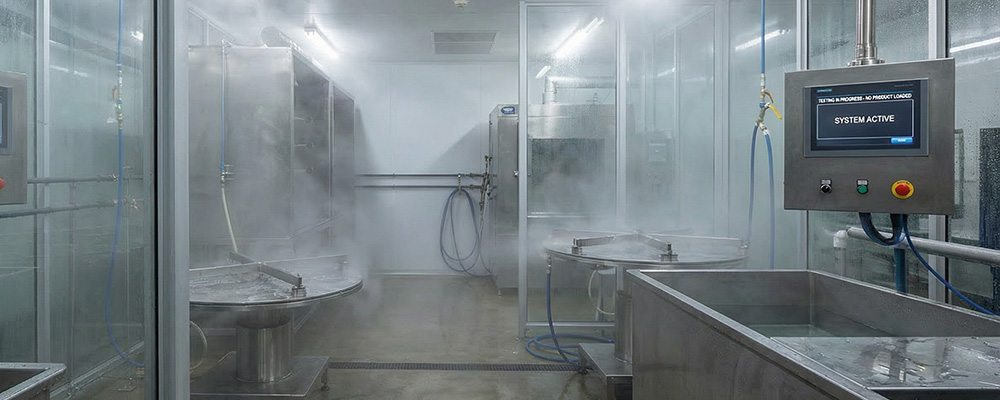
Environmental reliability testing evaluates whether an electrical appliance can operate consistently across different geographical regions and climate conditions. For products intended for global markets, this stage is particularly critical. Testing typically begins with exposure to extreme temperature and humidity variations. High- and low-temperature storage and operating tests serve as baseline evaluations, verifying material stability, assessing assembly risks arising from dimensional tolerance shifts, evaluating cold-start capability, and determining sustained operation under elevated temperatures. Humidity-related tests—such as steady-state damp heat and cyclic humidity—focus on assessing PCB resistance to ionic migration, insulation margins, and the moisture-sealing performance of enclosures and critical gaps, thereby reducing the risk of condensation-induced short circuits and corrosion.
Beyond standard temperature and humidity tests, application-specific environmental evaluations are equally indispensable. For outdoor use or marine transport scenarios, salt spray testing is often mandatory, simulating the corrosive effects of high-salinity environments on metal components, connectors, and surface coatings. Light ageing tests, including UV exposure, simulate long-term sunlight radiation to verify whether plastic parts exhibit yellowing, chalking, or embrittlement—factors that directly impact both cosmetic lifespan and structural integrity. Water and dust ingress testing (IP ratings) quantitatively assesses the product’s resistance to liquid and particulate intrusion through spray, immersion, and dust chamber methods, ensuring that sensitive internal components remain protected under complex operating conditions.
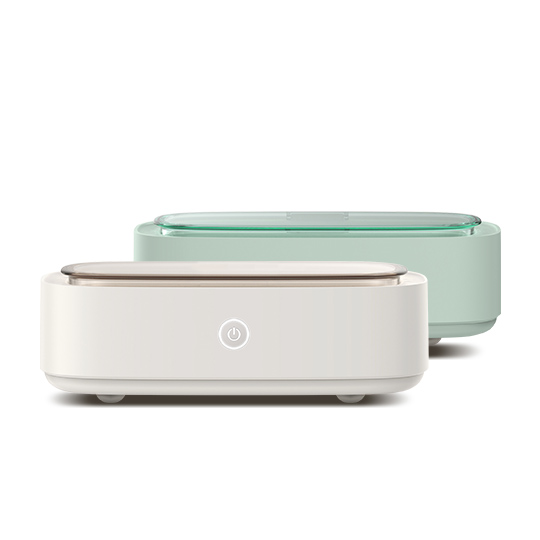
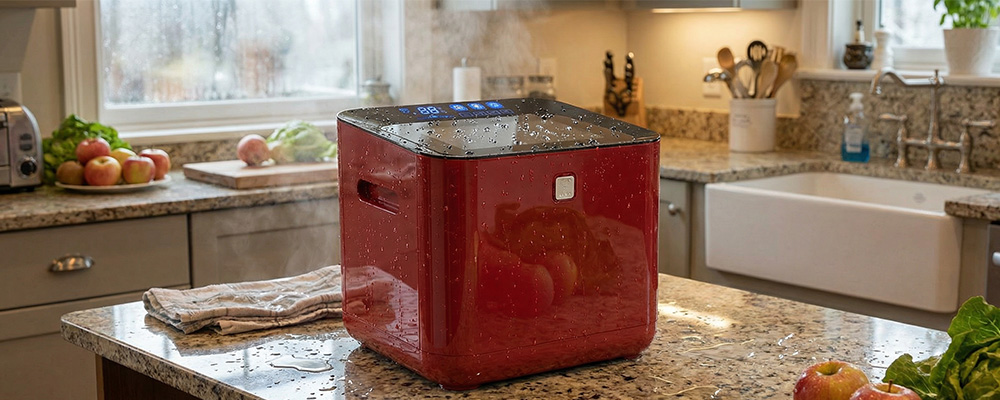
To illustrate this more concretely, consider a countertop fruit and vegetable washing appliance developed and manufactured by our team. Designed for prolonged use near kitchen sinks, the product is exposed to persistent humidity and frequent water splashing, resulting in a high risk of moisture ingress. During environmental validation, in addition to standard temperature and humidity cycling, enhanced waterproof testing is conducted on the control panel, critical seams, and potential water-entry paths. The appliance is operated in a high-humidity environment under full ultrasonic output with continuous bubble agitation, while also simulating wet-hand operation and external splashing. Following extended damp-heat ageing, the unit is disassembled for inspection, with particular attention paid to signs of condensation on the control board, oxidation trends at button contacts, and any degradation of sealing compounds around ultrasonic transducers due to thermal expansion and contraction. This stringent, use-scenario-driven validation significantly enhances durability and consistency in real kitchen environments.
Mechanical Reliability: Structural Strength and Component Durability
Electrical appliances are subjected to various physical stresses during transportation, warehouse stacking, and everyday use. Mechanical reliability testing verifies structural integrity and assembly stability under such conditions. Vibration testing simulates continuous shocks encountered during road and air transport. Through sine and random vibration profiles, engineers inspect for loosened fasteners, detached connectors, cable harness abrasion, and potential structural resonance issues. Drop testing recreates common accidental scenarios by dropping products from various heights and orientations onto concrete or wooden surfaces, assessing the impact resistance of enclosures and the reliability of internal vulnerable components, such as batteries, display modules, and mounting posts. For products with higher impact resistance requirements, IK rating tests may also be introduced, using steel-ball impacts to quantify protective performance.
Beyond overall structure, frequently interacted components are a major focus of mechanical reliability. Connector insertion and extraction force tests subject USB, HDMI, and similar ports to thousands—or tens of thousands—of mating cycles to verify contact spring elasticity and plating wear resistance, reducing the risk of intermittent failures caused by poor contact. Button and switch lifetime testing is typically performed using robotic actuators, repeatedly actuating controls to assess microswitch fatigue life, changes in actuation travel, and degradation in tactile feedback. For hinged or rotating structures, hinge life and torque decay testing are equally critical. These seemingly minor mechanical parameters often shape users’ first impressions of build quality and have a direct impact on long-term failure rates and brand perception.
Electrical Safety: The Baseline for Risk Control and Market Compliance
Electrical safety testing is a fundamental prerequisite for entering international markets, with the primary objective of preventing electric shock, overheating, and fire hazards. Dielectric withstand (hi-pot) and insulation resistance tests form the foundation, applying specified voltages between live parts and accessible enclosures to verify insulation integrity and safety margins, ensuring no breakdown occurs under fault conditions. Leakage current testing simulates typical human contact scenarios, measuring non-functional current levels to confirm compliance with applicable standards. Ground resistance testing verifies that, in the event of insulation failure, the protective earth path remains effective in conducting fault current safely to ground, thereby reducing electric shock risk.
Temperature rise testing is among the safety evaluations most closely linked to product structure and performance. Under full-load or overload conditions, multi-channel temperature recorders monitor transformers, power devices such as MOSFETs, electrolytic capacitors, and enclosure surfaces. This testing not only prevents burn hazards but also mitigates long-term performance degradation and reduced service life caused by sustained overheating. Flammability testing—such as glow-wire and needle-flame tests—verifies the flame-retardant and self-extinguishing properties of enclosures and structural supports under electrical fault conditions, preventing fire propagation. Together, these tests establish the baseline framework for product safety and regulatory compliance.
Using the household produce purification washer as an example once again, the product employs hydroxyl-based residue removal technology, in which a core generator produces hydroxyl radicals through an electrolysis process in water. This inherently involves stronger coupling between live electrodes and the water medium, placing higher demands on electrical isolation and protective design. As a result, safety testing extends beyond dry-condition insulation verification to more realistic and stringent operating scenarios. Simulated water with varying conductivity levels—reflecting differences in tap water across regions—is used while both the ultrasonic system and generator operate simultaneously at full power. Leakage current to ground and to user-accessible parts is continuously monitored. Ageing factors are also introduced to validate critical insulation paths and protection circuits over time, ensuring that multiple isolation layers and protective mechanisms remain effective throughout the product’s service life, thereby maintaining a stable safety boundary.
Electromagnetic Compatibility (EMC): Signal Integrity and Immunity
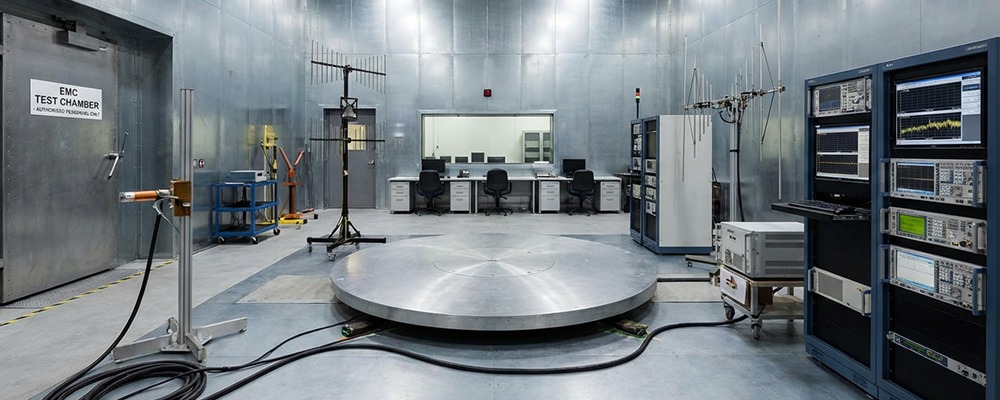
In today's environment of densely packed wireless devices, EMC testing primarily addresses two issues: ensuring that products do not generate unacceptable electromagnetic interference (EMI), and ensuring that products have sufficient immunity to external interference (EMS). During EMI testing, laboratories measure conducted and radiated emissions via power lines and free space in shielded chambers or equivalent setups, confirming compliance with regulatory and certification limits and preventing interference with televisions, medical equipment, or communication systems. Products with integrated wireless functions also require RF testing to verify transmit power, receiver sensitivity, and spectral purity, ensuring stable and consistent connectivity.
Electromagnetic susceptibility (EMS) testing focuses on product immunity. Electrostatic discharge (ESD) tests simulate high-voltage static electricity generated by human contact in dry environments, verifying that the product does not freeze, reset, or suffer permanent damage. Surge testing simulates high-energy transients caused by lightning strikes or grid switching events, evaluating protection at the power interface. Electrical fast transient (EFT) and voltage dip tests simulate complex disturbances caused by unstable power supplies. Systematic EMC validation significantly reduces the likelihood of malfunction, data loss, and sporadic field failures, enabling stable operation in complex electromagnetic environments.
Lifetime and Limit Testing: Predictive Evaluation and Design Optimisation
To deliver durable and consistent products to the market, manufacturers must predict and verify service life and performance limits through targeted testing. Highly Accelerated Life Testing (HALT) is a representative destructive validation method, applying temperature extremes and random vibration beyond specified limits to rapidly expose weaknesses in design and process. This allows early corrective action during development, improving overall reliability. For portable or battery-powered products, battery performance testing is equally critical, typically covering charge–discharge cycle life, capacity fade curves, and validation of BMS protection logic to assess long-term endurance and safety.
In addition, different product categories require dedicated performance tests. Audio products undergo acoustic testing to analyse frequency response and distortion, while ultraviolet disinfection products require optical testing to measure irradiance, wavelength distribution, and lumen depreciation to support consistent sterilisation performance. Combined hardware–software stress testing should not be overlooked; extended full-load burn-in tests help screen early failures and verify long-term system stability. Together, these tests—covering physical lifespan, functional limits, and delivery consistency—form a critical quality gate that reduces batch variability and post-launch quality risks.
User Experience Performance: Sensory Quality Beyond Compliance
As market competition intensifies, experiential metrics such as noise, vibration, tactile feedback, and interaction stability are gaining increasing importance—particularly in kitchen appliances, personal care devices, and smart home products. Acoustic performance and user comfort often have a direct impact on ratings and repeat purchase intent. In practice, ODM manufacturers support brands through noise testing, vibration evaluation, and structural resonance analysis, optimising experiential details while still meeting regulatory and baseline performance requirements. Although these tests are not always mandatory or standardized, they often determine the degree of product differentiation and the long-term premium pricing potential of a brand.
Defining Manufacturing Excellence Through Rigorous Standards
From environmental adaptability and safety compliance to EMC, lifetime prediction, and experience optimisation, the value of performance testing lies not merely in “passing a test,” but in shifting risk upstream, closing data loops, and transforming quality into reusable engineering capability. For electrical and electronic products targeting global markets, a traceable, quantifiable, and iterative test framework often serves as the common foundation for R&D efficiency, mass production consistency, and sustained market reputation.
At ATYOU Health Tech, we regard a scientifically grounded testing system as a cornerstone of our R&D and manufacturing processes. Through stringent validation standards and precise quality control, we are committed to delivering safe, reliable, and competitive product solutions for global brands. We believe that only products refined through rigorous validation can remain resilient in highly competitive markets. If you are exploring customised development of high-performance cleaning or innovative appliances, we welcome further discussion and the opportunity to collaborate on creating industry-leading solutions.
 No. 1-A, Kechuang Center, No. 289 Wengjiao Rd., Haicang Dist., Xiamen, 361000, Fujian, China
 (86)0592-5626338
Subscribe to our newsletter
Our parent company

Xiamen Qiqiangsheng Moulds Co., Ltd.
Copyright © 2012-2026 Xiamen Atyou Health Technology Co., Ltd. All Rights Reserved.

 English
 español