Categories
New Blog
What Should Be Defined Before Product Development Begins? An Example from Cleaning Equipment
The development of a new product often carries high expectations for a company entering a new market or proving a new concept. As market competition accelerates, launch windows are shrinking. Bringing a product efficiently from concept to mass production—while securing early-mover advantage—has become critical. Yet in practice, many product development projects, particularly in hardware and consumer electronics, frequently face delays.
While delays are often blamed on technical complexity, the root cause usually lies elsewhere. What truly determines long-term efficiency is rarely how quickly engineers begin drawing schematics or how difficult the technology is. It is whether the team defined what is being built clearly before the project ever started.
During initial market research, product owners often feel they have a clear vision—for instance, developing an "ODM Special household cleaning appliance" or a "portable cleaner for personal items." But to engineers, contract manufacturers, or ODM partners, a mandate like "build a nice useful household cleaning device" is far too vague to serve as an actionable development input. What needs to be cleaned, why it needs cleaning, the desired performance level, the usage environment, the user interaction flow, the target export market, and the unit cost and timeline constraints all directly dictate the choice of technical approach, structural design, key components, and validation methods.
Therefore, before officially launching product development—especially in multi-team or cross-company projects—the product owner's priority should not be picking specific off-the-shelf components or locking in a technology. Instead, it is converting product requirements into a structured set of conditions that engineering teams can evaluate, execute, and validate.
Product development should begin with user needs, not technical solutions.
In specialized cleaning appliances, "cleaning" is a broad concept. Different products deal with different contaminants, target objects, and operating environments, leading to fundamentally different engineering requirements. Product owners must clarify what problem the product is meant to solve: Is it removing dust, grease, and residue, or reducing microbial contamination? Is it handling standard hard surfaces, or must it protect delicate materials from damage? Is it designed for single-item processing or batch cleaning?
At the same time, the target user's real-world scenario and the flaws of existing solutions must be articulated. Is the traditional cleaning process too tedious? Is the performance inconsistent or time-consuming? Is current equipment cumbersome, or are users simply looking to reduce manual effort?
This context is far more valuable than asking to "develop an efficient cleaning device." Engineering teams solve concrete operational problems, not abstract adjectives. Product owners should also distinguish between "product functions" and "results." Technologies like ultrasonics, sprays, vibration, or mechanical vibrations are merely means to an end. At the project kick-off, the focus should be on defining the required outcome rather than restricting the team to a specific mechanism prematurely.
The physical design of a special cleaning device depends heavily on the object it cleans.
Before development begins, define the target object's physical characteristics as clearly as possible—size, material composition, shape, weight, surface properties, and any fragile regions. If the product handles multiple item types, separate the primary target from secondary ones. For example, while both use ultrasonic technology, a fruit and vegetable washer and a personal care ultrasonic cleaner have completely different design priorities. The former must accommodate varied food dimensions, surface structures, water treatment, and food-contact compliance. The latter must accommodate the materials, structural gaps, and cleaning requirements of glasses, jewelry, or personal care items.
If the primary target objects are already known, providing physical samples, photos, dimensions, or typical operating setups early in the process gives engineers a concrete baseline to evaluate technical feasibility far better than text alone.
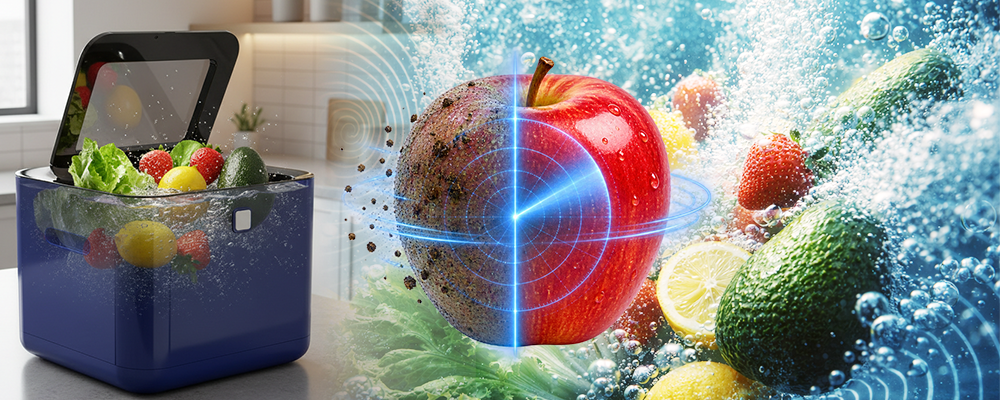
Phrases like "cleans better," "high performance," or "deep cleaning" work well in marketing, but offer no measurable criteria for engineering development.
Product owners should translate expected cleaning outcomes into verifiable test conditions. For example, specify the removal rate required for target contaminants under specified cleaning time, operating procedures, and usage conditions, alongside the corresponding evaluation methods. Additionally, draw clear lines between cleaning, antibacterial action, disinfection, and sterilization. These represent distinct functional tiers and verification requirements. If a product simply removes stains or residues, avoid using vague claims like "sanitizing" in engineering briefs. If antibacterial or disinfection capabilities are truly required, establish those targets, scope, and test standards early in the project.
The earlier you define "what success looks like," the easier it is to set up engineering validation protocols—avoiding scenarios where a prototype works mechanically but fails brand expectations.
The physical operating environment and user workflow directly impact structural design, capacity, sealing, drainage, control interfaces, and component lifespans.
Before development starts, specify where the product will primarily be used—at home, in an office, in hotel rooms, or elsewhere. Define who the user is, usage frequency, and whether the device needs to be portable or stowed away easily. Map out the basic user flow: how items are loaded, whether water or cleaning agents must be added, typical cycle times, and how the user removes items, drains fluid, and performs routine maintenance.
These requirements should not wait for the industrial design phase. If a product requires frequent filling and draining, water tank capacity, inlet geometry, and drainage pathways must be factored in early. If portability is key, overall weight, dimensions, power delivery, and structural durability become fundamental initial constraints.
At project kick-off, distinguish between mandatory features, optional enhancements, and items deferred to future iterations.
Basic controls, operating modes, and status indicators usually form the core product feature set. Advanced additions like Wi-Fi, mobile apps, data logging, or complex smart controls should be evaluated against real user needs and commercial value for target markets.
Adding features does not automatically add product value. Every extra feature brings additional electronics, software development, physical enclosure constraints, testing routines, and supply chain dependencies. For a first-generation product, defining the core user experience and clear feature boundaries is far more critical to moving swiftly through engineering validation toward mass production.
Product owners do not need to lock down final product dimensions from day one, but they must identify any firm spatial constraints and regional power requirements—including operating voltage, frequency, plug configurations, and power delivery methods.
If the appliance integrates components like water systems, motors, heating elements, ultrasonic transducers, or pumps, outline the operating conditions upfront. This includes single-cycle runtimes, expected daily duty cycles, and protection requirements under normal and fault conditions.
These baseline parameters dictate system architecture and critical component selection. Setting them early prevents costly redesigns caused by changing foundational specs after functional prototypes are built.

For appliances intended for Western markets (North America and Europe), target regions must be designated early. Regulatory frameworks across the US, the EU, and other regions differ significantly in electrical safety, electromagnetic compatibility (EMC), chemical compliance, wireless certifications, and material safety standards.
If a product involves food contact, water contact, human contact, or specialized applications (such as Residential Food Washers), relevant material safety and hygienic standards must be integrated into initial specs rather than audited post-prototype.
Late compliance integration often forces redesigns of approved materials, structure, or electronic solutions, leading to severe schedule slippage and budget overruns.
Engineering teams need to understand the commercial positioning of the product. While an exact Bill of Materials (BOM) cost cannot always be fixed at kickoff, providing a target price range, market tier, projected order volumes, and roll-out strategy is essential.
These inputs shape choices across materials, electronic components, display interfaces, tooling investments, manufacturing processes, and automation levels. A low-volume market test product requires a fundamentally different design and tooling strategy than a product designed for high-volume retail distribution.
Similarly, market launch timelines mean more than just "when the prototype is done." The path from initial concepts and engineering design to certifications, tooling, pilot runs, and mass production involves multiple interdependent milestones. Product owners should establish key target dates for concept sign-off, prototype testing, regulatory certification, field testing, and mass production, then work backward to build a realistic timeline.
Crucially, distinguish between a "functional prototype" and a "market-ready mass-production unit." Bridging that gap requires rigorous performance, reliability, manufacturing consistency, regulatory, and DFM (Design for Manufacturability) validations.
A complete development input should answer one core question: Under what conditions is the product development considered successful?
This covers functional completeness, performance targets, standardized cleaning test metrics, runtime and noise limits, and operational stability under defined conditions.
Consider long-term maintenance as well. For cleaning appliances, ensure fluid pathways, containers, filters, and gaskets are easy to clean, free of standing water traps, and straightforward for end users to maintain.
Introducing these criteria late in the cycle frequently leads to rework. Establishing acceptance criteria upfront allows R&D teams to choose architectures and validate prototypes against clear, agreed-upon targets.
Product owners do not need to finalize technical implementations before the project starts.
Specifying motors, pumps, ultrasonic transducers, control IC, or specific mechanical structures too early can restrict engineers from finding better, more cost-effective solutions. A more effective approach is to define the "required outcomes" and "design constraints," leaving the technical implementation to the engineering team to evaluate through testing.
For instance, specify target cleaning efficacy, cycle duration, capacity, noise thresholds, size limits, target costs, and regulatory markets—but allow the technical team to determine the optimal actuators, drive electronics, structural layout, and control logic based on empirical testing.
This approach enables engineering and ODM partners to actively contribute to product definition rather than simply executing drawings.
An effective product development brief enables the engineering team to answer several core questions right at kick-off: Who are we solving a problem for, and what is that problem? What object are we handling? What result must be achieved? Where will it be used? What are the hard limits on dimensions, cost, and compliance? What is the deadline? And what defines successful completion?
For products like specialized cleaning appliances—which may appear straightforward but rely on an integration of mechanical, electronic, acoustic, fluidic, material, and manufacturing engineering—the outcome depends on how target objects, operating principles, structural design, and user interactions work together.
The most important step before starting development is not making technical solutions as granular as possible, but defining the actual problem, hard constraints, and verifiable outcomes clearly.
For brands and buyers, this clarity is also the best gauge of whether a contract manufacturer or ODM partner truly understands the project. A capable development partner does not just accept a brief and start drafting drawings; they identify missing details or conflicting requirements early, raise critical questions, and build a sound technical roadmap aligned with product targets, cost, market needs, and mass-production realities.
In the end, development efficiency is rarely about how fast an engineering team draws schematics later on—it depends on whether both sides shared a clear consensus from day one on what is being built and what defines success.
 No. 1-A, Kechuang Center, No. 289 Wengjiao Rd., Haicang Dist., Xiamen, 361000, Fujian, China
 (86)0592-5626338
Subscribe to our newsletter
Our parent company

Xiamen Qiqiangsheng Moulds Co., Ltd.
Copyright © 2012-2026 Xiamen Atyou Health Technology Co., Ltd. All Rights Reserved.

 English
 español