Categories
New Blog
How Do Manufacturers and ODM Teams Analyze User Needs Before Custom Product Development?
For a custom product to be developed as intended and successfully brought to market, user needs analysis is an important step before development begins. Brands and buyers responsible for defining product requirements often conduct extensive market research to organize and summarize these needs. This research may include user interviews, surveys, focus groups, and market data analysis. However, if the goal is to make product development faster and more efficient, a user requirements document provided by the customer is not enough on its own. The development team, or the technical team at an ODM manufacturer, also needs to develop a thorough understanding of the actual product requirements.
For engineering teams responsible for custom product development, especially ODM manufacturers working with brands to develop new products, the goal of user needs analysis is usually not to build an entirely new set of product requirements from scratch. Instead, it is to understand and supplement the requirements already established by the customer and translate them into product and technical requirements that can be discussed and validated. ODM manufacturers often have an advantage here because they are not starting from scratch when learning about a product category. Years of involvement in product development, pilot production, and mass production build up a wealth of knowledge about product use, structural solutions, material selection, failure issues, and user feedback. When evaluating a new product concept, the development team therefore needs to determine within a limited time what the customer already knows, which requirements remain unclear, which needs can be inferred from user behavior and existing products, and which questions must be validated before engineering development begins.
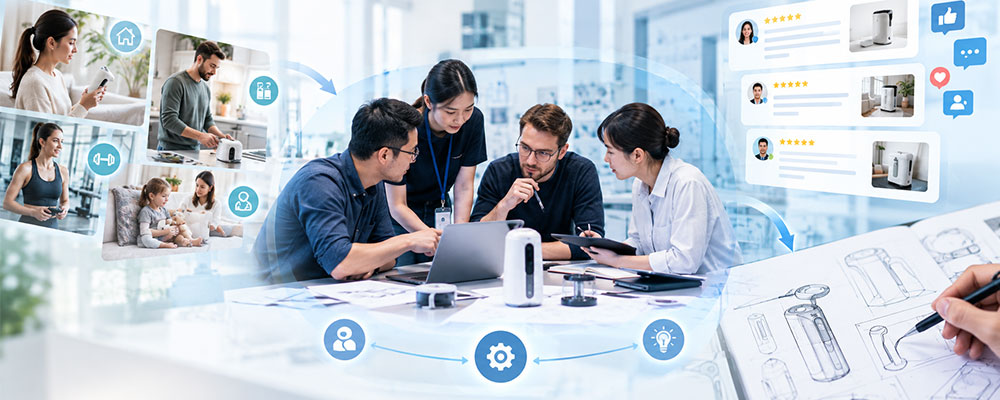
This analysis does not necessarily require complex or lengthy market research. Based on ATYOU Health Tech's years of experience providing ODM/OEM services, a practical approach for many consumer electronics and electrical appliances is to start with actual usage scenarios and user behavior, then cross-reference those findings with previous products, competitor reviews, specifications, structural designs, and manufacturing quality experience. This often helps turn early-stage product concepts into requirements that can be discussed and validated more quickly.
Shift the Focus from What Users Say to How They Actually Use the Product
One of the most practical and efficient ways for an engineering team to analyze user needs is to walk through a complete product usage cycle from the user's perspective.
Compared with simply asking what features users want, observing how they complete a task is often more effective at revealing the real problems. Users may say they want a product that is "easy to use," but the actual issue may be frequent plugging and unplugging, repeated setup, too many cleaning or maintenance steps, or difficulty telling whether the product is operating normally after it has been switched on.
At the beginning of product development, the user's behavior can therefore be broken down into a series of steps: Why does the user need this product? Under what circumstances do they take it out? What needs to be prepared before use? How do they position or connect the product? What do they need to wait for during operation? How do they confirm the result? After use, how do they clean, store, or maintain the product?
For example, if a UV air purifier is designed for bedrooms or office spaces, the analysis should go beyond the basic requirement for UV functionality. It should consider when users turn on the device, whether they expect it to run continuously, whether they use it when people are present, how they know air treatment is taking place, and whether operating noise, light, odors, or status indicators affect the user experience. Different usage patterns can lead to different requirements for safety design, control logic, and user interaction.
The practical advantage of this "scenario–behavior–problem" approach is that the team does not need extensive user data from the outset. It can work with the brand's existing research findings to identify which needs are most likely to affect product design.
Use Previous Products to Identify What Has Worked in Practice
Another important source of information is the team's experience with previous product projects. For engineering teams that regularly develop products in the same category, particularly ODM manufacturers, this is a significant advantage during needs analysis.
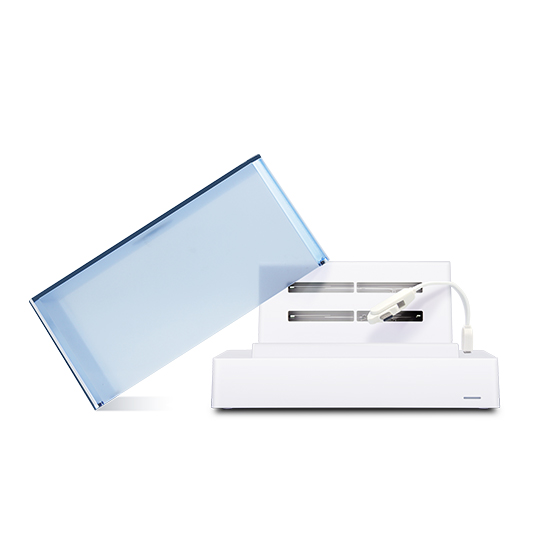
Previous products should not simply be presented as examples of similar products the team has developed. More importantly, the team should examine why earlier solutions worked or fell short of expectations, as well as which problems emerged after products entered mass production but were not identified during the initial design stage. For example, when developing a custom UV sterilization box, the team can review issues encountered with similar products involving internal space, lid detection, item placement, interior-wall reflectivity, heat dissipation, and changes in performance over extended use. These lessons may not translate directly into a new design, but they can help the team identify risks that need to be validated earlier.
Previous projects can also help distinguish between what is theoretically feasible and what performs consistently in actual mass production. A particular structure may work well in a prototype but be prone to assembly tolerance issues, material deformation, inconsistent sealing, or variations in the performance of key components during mass production. This information is part of product requirements analysis because it affects which solutions are genuinely suitable for the final product.
Use Online Competitor Reviews to Identify What Users Are Really Dissatisfied With
Competitor reviews help engineering teams connect existing project requirements with real user feedback during the early stages of requirements analysis. Product pages typically highlight what brands want customers to notice, while user reviews are more likely to reveal problems that arise during actual use. Low ratings and recurring complaints are often more useful than promotional feature lists.
For example, complaints about UV air purification devices may have little to do with the effectiveness of the UV technology itself. Instead, users may be concerned about noise, complicated operation, consumables, replacement parts, status indicators, or difficulty determining whether the device is working. Reviews of UV disinfection lamps may reveal issues with installation, coverage, timers, or safe operation. These reviews can also help the team assess how different features affect the actual user experience and inform decisions about requirement priorities.
These reviews should not be treated as a direct representation of market demand, since online reviews can be affected by sampling bias and users may not describe problems accurately. However, if the same issues appear repeatedly across multiple products and platforms, they should be added to the requirements analysis list and validated further during engineering development.
Examine Competitor Specifications and Designs to Understand Existing Solutions
User reviews tell us where customers are dissatisfied, while competitor specifications and structural designs help explain how the market is currently addressing those problems.
The real value of this step lies in examining the structures used in different products, how key components are arranged, how user workflows are designed, and which design choices are becoming common across products.
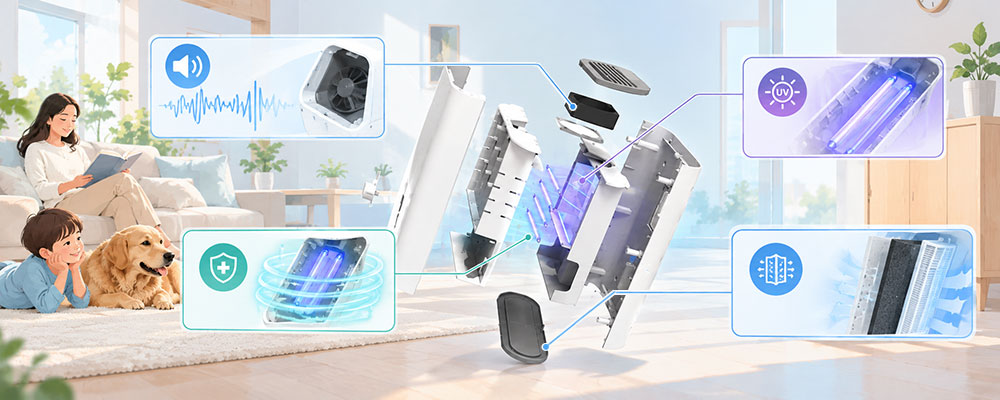
For example, in custom UV air purifier development, the team can examine airflow design, the arrangement of fans and filter media, filter replacement mechanisms, light source placement, and maintenance procedures, then analyze which problems each design is intended to address.
This analysis helps manufacturers quickly determine whether a requirement is a basic expectation for the product category or a design feature that differentiates a particular product.
At the same time, competitor designs should not be adopted directly as the basis for a new product. The primary purpose of competitor analysis is to understand the solutions already used in the market, then evaluate which are worth adopting and which need to be redesigned based on target cost, manufacturing processes, reliability, and product positioning.
Work Backward from Manufacturing and Quality Issues to Identify User Needs
For ODM manufacturers with extensive experience in product development, pilot production, and mass production, manufacturing and quality records are another valuable source of information for needs analysis.
Many user needs are not explicitly stated by customers. Instead, they are reflected in manufacturing and quality issues. For example, frequent sealing failures during mass production may indicate that users need more consistent protection against water or other external factors. A component that tends to loosen after extended use may point to a need for better structural retention and durability. A material that deforms easily during assembly may affect product consistency over time.
These issues should not be treated simply as manufacturing problems. If a manufacturing issue ultimately affects the user experience, product life, or safety, it is also a product requirement. Records accumulated by manufacturing and quality teams can help R&D engineers identify risks early in the product definition stage rather than waiting until mass production to address them.
The Goal Is Not to Redefine Requirements, but to Translate Them into Engineering Terms
Once the customer's project team has completed market research and established a list of user requirements, the purpose of early user needs analysis by the development team or ODM manufacturer is not to create an entirely new set of requirements. It is to gain a deeper understanding of the existing requirements, fill in missing details, translate conceptual descriptions into product requirements that can be discussed and validated, and determine which requirements will directly affect the technical approach.
Requirements lists provided by brands often remain at the level of user language and product concepts. By cross-referencing usage scenarios, previous projects, competitor reviews, product specifications and designs, and manufacturing and quality experience, the development team can better determine what problems users actually need to solve, which requirements are already clear, which still need validation, and how these requirements may affect product structure, cost, reliability, and mass production.
For example, if a customer requests the custom development of a "quiet household UV air disinfection device," the engineering team needs to clarify whether "quiet" refers to airflow noise during continuous operation or also includes startup and shutdown sounds, structural vibration, and other factors. Different interpretations may lead to different technical requirements. Through this analysis, a conceptual request can gradually become a product requirement suitable for engineering discussion, by a corresponding technical approach and key validation priorities.
Therefore, one of the keys to improving the efficiency of custom product development is ensuring that the development team accurately understands the requirements and identifies the associated technical requirements and development priorities as early as possible. Good requirements analysis does not necessarily mean gathering more information. It means identifying, from the information already available, the issues that will have the greatest impact on the product's direction.
Based on ATYOU Health Tech's years of experience providing customers with custom cleaning appliance and disinfection equipment development and manufacturing services, conducting user needs analysis early in the process is an important way for technical teams to contribute to product definition. It also provides a solid foundation for moving products from concept to engineering development, validation, and mass production more efficiently. Drawing on accumulated experience in product development, pilot production, mass production, and quality control helps customers turn a product concept into a solution that is ready to move into engineering development, validation, and mass production more quickly
.
 No. 1-A, Kechuang Center, No. 289 Wengjiao Rd., Haicang Dist., Xiamen, 361000, Fujian, China
 (86)0592-5626338
Subscribe to our newsletter
Our parent company

Xiamen Qiqiangsheng Moulds Co., Ltd.
Copyright © 2012-2026 Xiamen Atyou Health Technology Co., Ltd. All Rights Reserved.

 English
 español