Categories
New Blog
How to Evaluate a Manufacturer's DFM Capabilities: Scope, Deliverables, and Red Flags
We believe most brands and product developers understand the value of DFM (Design for Manufacturability) in custom product development. When looking for an ODM manufacturing partner, a supplier's DFM capabilities are often seen as an indicator of its engineering strength. However, assessing these capabilities is not always easy. Some manufacturers claim to offer DFM services, but their actual work may be limited to checking drawings before providing a quote, pointing out a few manufacturing issues, or asking the customer to revise the design themselves. In our years of experience at ATYOU Health Tech, we have also heard customer feedback about suppliers requesting design changes without fully explaining the technical reasons. This makes it difficult for customers to judge the basis for these recommendations. Are they intended to reduce mass production risks, accommodate the supplier's existing manufacturing capabilities, or address cost and process considerations?
This article breaks down what brands should look for. When a supplier says, "We provide DFM," there are four things brands should examine: the scope of the review, the basis for its recommendations, whether the proposed improvements are practical, and whether there is a follow-up validation and issue-closure process. A quotation alone cannot tell you these things. Neither can a well-formatted report. The following methods and questions can help procurement, product development, and supply chain teams evaluate potential suppliers. They are not a one-size-fits-all template. The appropriate scope of a DFM review naturally varies depending on the product, manufacturing process, and project stage.
What Should a DFM Review Actually Cover?
We have already discussed the DFM methodology in a previous article (see DFM/DFMA: Optimizing Production from the Product Design Phase), so we will not repeat it here. This section focuses on one question: What should you expect a supplier to review?
A proper DFM review generally covers six areas. First, whether the part design is suitable for the intended manufacturing process. A plastic housing designed for injection molding should be evaluated in terms of draft angles, wall thickness, and shrinkage. It should not be assessed using sheet metal design principles. Second, how material selection affects manufacturing and product performance. For example, the inner chamber material of a UV disinfection product needs to resist discoloration and brittleness under UV exposure while also supporting consistent injection molding. These two requirements can sometimes conflict. Third, tolerances, part interfaces, and dimensional stability. The clearance between two mating parts and the choice of locating reference directly affect how smoothly they can be assembled. Fourth, assembly processes and inspection feasibility. Being able to assemble a product is one thing; ensuring that every unit can be assembled consistently and inspected on the production line is another. Fifth, mold design, tooling, and mass production risks. Can potential issues involving mold slides, lifters, and venting be identified before mold development begins? Finally, the review should identify engineering questions that cannot yet be answered and will need to be validated through prototypes, testing, or trial production.
Not every project needs to cover all six areas in equal depth. A simple baby bottle dryer and a custom specialized UV disinfection cabinet with a sealed chamber and multiple sensors have very different review priorities. Our usual approach is to identify high-risk areas based on the product type and intended manufacturing process, then decide where to focus the review. In actual projects, a detailed review of three to five critical issues is often more valuable than a broad but shallow review. Brands can ask suppliers directly: For this product, which areas will you focus on, and why? The answer itself can reveal a lot about their capabilities.
What Should a Manufacturer Deliver After a DFM Review?
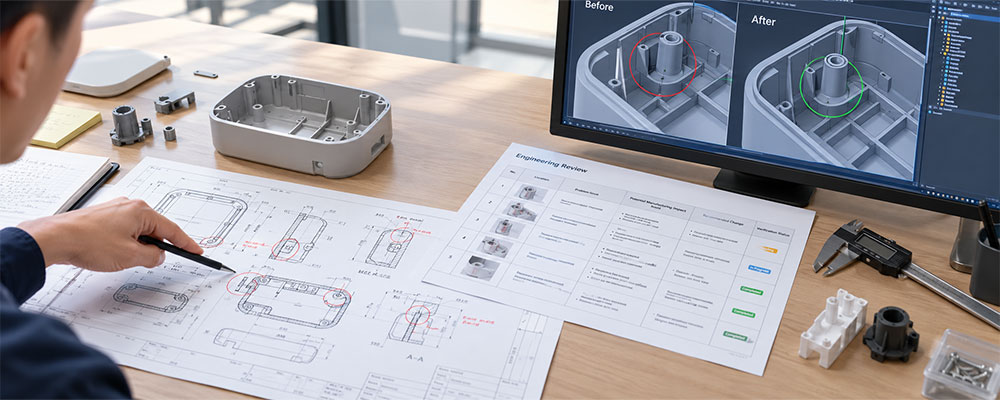
This is where many brands run into trouble for the first time. The review is done, the call went well, and the feedback is simply: "The structure needs to be optimized. We recommend adjusting the wall thickness." Then what? What needs to change? By how much? What happens if nothing changes? Who revises, and who confirms it afterward? None of these questions is answered.
A useful DFM report should help brands understand six things, even if they are not familiar with manufacturing processes: What problem was found, and where exactly is it located? Why could it affect manufacturing, assembly, performance, or quality? What changes are recommended, and what trade-offs might they involve in terms of cost, molds, appearance, or function? Which decisions need the brand's confirmation? Which risks are still assumptions and need to be validated through prototypes, testing, or trial production? Who is responsible for following up, and how will the issue be confirmed as closed? Without the first two points, brands cannot judge whether a recommendation is necessary. Without the last three, problems can easily resurface after design freeze.
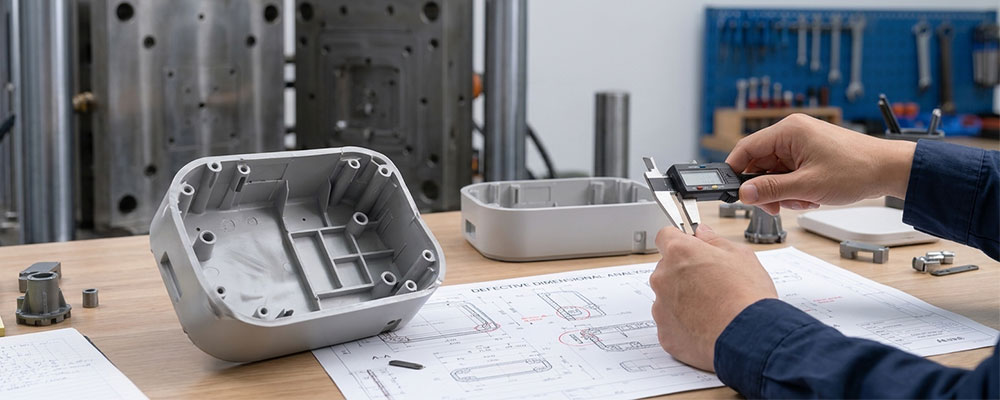
Consider a common situation. A prototype of a portable UV disinfection box is placed on the table. When the lid is closed, one side fits tightly, but a narrow gap remains on the other side, leaving the LEDs inside visible. The engineer measures it with calipers and determines that the issue is not caused by prototype fabrication errors. Instead, the latch on the lid is too far from the hinge, so slight warping of the plastic part prevents it from sitting flush. The feedback given to the brand should not simply say, "The latch needs to be adjusted." It should explain the issue clearly. The problem is the relative position of the lid latch and hinge. The latch sits too far from the hinge, so the closing force cannot compensate for part warping. The recommended fix is to move the latch inward or add a middle latch point. This adds a feature inside the lid and requires an extra slide in the mold. The brand needs to confirm whether the change affects the exterior appearance. After the change, the closing gap should be rechecked with a new prototype, by sampling during trial production.
The table below shows one example of how DFM issues can be recorded. It is not a fixed format that every project must follow. Its purpose is to make sure every recommendation has a clear basis and a defined follow-up. The examples are illustrative and are not taken from any specific project.
Issue
Basis
Recommendation
Responsible
Party
Validation
Method
Status
A
gap remains on one side when the lid is closed
The
latch is too far from the hinge, and the closing force is insufficient to
compensate for part warping
Move
the latch inward or add a middle latch point; the mold will require an
additional slide
The
manufacturer's structural engineer makes the change; the brand confirms any
impact on appearance
Recheck
the closing gap with a new prototype; conduct sampling inspections during trial
production
Awaiting
brand confirmation
Risk
of discoloration of the chamber's inner wall material after long-term UV
exposure
No
UV resistance data is available for the currently selected material grade
Switch
to a material grade with documented UV resistance or add a reflective component
to the inner wall
The
manufacturer proposes alternative materials; the brand confirms the cost
Accelerated
aging test
Pending
validation
Electrical
protection, wire routing, and isolation between the power compartment and the
lamp chamber need further review
Insufficient
electrical isolation, moisture protection, or sealing may affect safety
Determine
the isolation solution based on the electrical design, structural design, and
applicable safety requirements
The
manufacturer's structural team makes the changes; the brand's quality and
compliance teams evaluate them
Check
electrical protection and sealing on the prototype
In
progress
UV
protection between the light source area and externally accessible areas needs
to be evaluated
Structural
gaps may allow UV light to reach externally accessible areas
Evaluate
whether light-blocking edges, UV-filtering structures, or interlock protection
are needed
The
manufacturer's structural team makes the changes; the brand's quality and
compliance teams evaluate them
UV
radiation testing on the prototype; test locations, conditions, and acceptance
criteria to be determined
Pending
validation
Bottom
screw boss wall thickness is below the material's recommended minimum
Thin
walls may crack during screw driving or handling
Increase
the boss wall thickness and add reinforcing ribs
The
manufacturer
Close
after reviewing the updated 3D data
Closed
The table does not need to be complicated, but it is best to keep all six columns. In our experience, the "Status" column is the one most often left out, even though it is especially useful for brands tracking follow-up actions. It makes it easy to see which issues have been addressed and which are still waiting for someone to take action. UV protection test requirements depend on the light source wavelength, product usage, and applicable safety standards. A DFM review can identify structural risks related to UV protection, but it cannot replace safety testing.

How Can You Assess the Quality of a Manufacturer's DFM Work?
Deliverables alone are not enough. You also need to evaluate their quality. We recommend using five criteria, each corresponding to a specific situation you may encounter.
1. Specificity
Does the supplier identify the exact part, structure, dimension, or manufacturing process involved? "The housing has a mold release risk" and "The side wall on the A-surface of the housing, near the button opening, has no draft angle and may be damaged during mold release" represent very different levels of detail. Anyone can make the first statement. The second shows that the supplier has actually reviewed your 3D data.
2. Technical Reasoning
Can the supplier explain why the problem occurs, rather than simply stating a conclusion? Suppose a supplier says that the welded area of an ultrasonic cleaner's tank is likely to leak. Ask why. If the supplier can clearly explain how the tank wall thickness, welding method, and transducer vibration are related, the recommendation deserves serious consideration. If the answer is simply, "The products we made before all had this problem," it is more of a general observation based on experience and may not apply to your design.
3. Actionability
Are the recommendations specific? Do they explain the benefits, drawbacks, and limitations? "We recommend changing it to a one-piece design" is a general direction, not a complete solution. A practical recommendation would be: "Change to a one-piece design. This can eliminate one assembly step and one sealing ring, but it will make the mold more complex, increase the unit cost, and may cause weld lines to appear on the exterior surface." Whether this option makes sense depends on the expected production volume, mold investment, unit cost, and assembly cost. For a low-volume project, eliminating one assembly step may not be enough to offset the additional mold investment. The exact break-even point depends on the mold design and material. The supplier should be able to explain how its estimate was calculated.
4. Validation
Can the supplier distinguish between confirmed problems and risks that still need to be validated, and suggest appropriate validation methods? A wall thickness below the recommended value can be confirmed directly from the drawings. Long-term UV resistance of a material cannot be determined from the drawings alone; it requires aging tests. If these two types of issues are grouped together and simply described as "risks," the brand cannot prioritize them effectively. A good supplier will clearly explain which three issues can be decided now and which two need to wait until prototypes are available.
5. Follow-through
After a design change is made, does someone review the affected parts? How is an issue confirmed as closed? This is the hardest criterion to evaluate during the quotation stage, but you can ask how the supplier has handled it in previous projects. One clear sign of a good process is whether the supplier proactively reminds you to check the mating dimensions of adjacent parts when one part is changed. Teams that do this usually have an established internal process for reviewing design changes.
Of these five criteria, the first three can usually be assessed during the initial discussion. The last two require more evidence from previous project records, actual work procedures, or the course of a working relationship. Based on the brand projects we have been involved in, the second and fourth criteria often make the biggest difference. Many suppliers can identify problems, but they cannot clearly explain the reasons or distinguish confirmed issues from assumptions.
DFM Red Flags and Questions to Ask a Potential OEM/ODM Partner
When evaluating a manufacturer, red flags should not be treated as automatic reasons to reject a supplier. Instead, they are signs that the brand should ask further questions. The table below matches common warning signs with questions you can ask directly. It can help procurement and product development teams determine whether the manufacturer truly understands the issue, can explain the basis for its recommendations, provides practical solutions, and has a process for validation and issue closure.
|
Red
Flag |
Suggested
Questions |
|
Only
gives conclusions such as "the design is not feasible" or "it
needs to be optimized," without technical explanations |
Can
you identify the specific part, structure, dimension, or manufacturing issue?
What causes the problem? |
|
Recommends
design changes without explaining their impact on function, performance, or
cost |
What
are the effects and trade-offs of this change in terms of function,
performance, cost, molds, or assembly? Which decisions require the brand's
confirmation or approval? |
|
Cannot
distinguish confirmed problems from risks that still need validation |
Which
issues have been confirmed? Which still need to be validated through
prototypes, testing, or trial production? |
|
Only
discusses key manufacturing issues during the quotation or mold development
stage |
What
do you review before providing a quote and before design freeze? How do you
document and prioritize manufacturing risks? |
|
Has
no clear process for reviewing design changes or closing issues |
After
a design change, who reviews the affected parts and manufacturing processes?
How do you confirm that the issue has been closed? |
This table can be used during supplier discussions or internal evaluations, but we do not recommend applying a mechanical scoring system. The key is to see whether the supplier's answers are specific enough to identify the part, dimensions, manufacturing process, or validation method involved, and whether they explain the technical basis, trade-offs, responsible parties, and issue status. If the answers remain at the level of "we can optimize it" or "we recommend making changes," continue asking until the supplier provides specific answers or makes it clear that it cannot.
A single red flag does not necessarily mean a manufacturer lacks the required capabilities. It is reasonable for a supplier that only handles injection-molded parts not to discuss complete product assembly. Similarly, a supplier brought into a project at the concept stage may not yet be able to distinguish confirmed issues from risks that still need validation. Brands should consider the product's complexity, the current project stage, and the actual scope of the supplier's responsibilities. In our experience, the same supplier may provide thorough DFM reviews for product categories it knows well, but offer only general suggestions when working with unfamiliar manufacturing processes. In such cases, the question is not simply whether the supplier has DFM capabilities, but whether it has the relevant capabilities for your specific product category.
DFM as Part of an Integrated Product Development Process
The deliverables, evaluation criteria, and questions discussed above all rely on one basic principle: DFM is not a one-time drawing review. Its value depends on whether review findings reach the people responsible for mold design, injection molding, assembly, and quality control, and whether those teams follow up on them at each stage. Even if a supplier correctly identifies every issue during a drawing review before providing a quote, that alone does not ensure the issues will actually be addressed during mold development and trial production.
ATYOU Health Tech is a wholly owned subsidiary of QQS Group. The group's mold division has been operating since 2004 and was the first department established within the group. We also have our own injection molding facility, which supports mold trials, small-batch trial production, and mass production. This setup makes DFM more practical: recommendations from structural engineers can be reviewed directly with mold designers and injection molding personnel in the same facility. Changes to the mold design can be discussed alongside their effects on injection molding parameters and assembly, rather than being passed among multiple subcontractors via email. Having product design, prototyping, testing, and mass production connected within the same system also means that risks marked "pending validation" have a clear path to closure, with a defined stage and method for addressing them.
This does not mean that we use the same DFM process for every project. The review scope and deliverables are adjusted according to the product category, the level of customer involvement, and the stage at which we join the project. When evaluating ATYOU or any other supplier, brands can use the five criteria and list of questions in this article to check whether the answers are specific, technically supported, practical, and backed by validation and a clear issue-closure process. A supplier that meets these requirements is putting DFM into practice. Without them, even the most complete-looking report is just a document.
There is one straightforward way to evaluate any supplier, including ATYOU: select a real part and ask the supplier to walk you through one DFM recommendation on the spot. Where is the problem? Why does it occur? How should it be fixed? What are the trade-offs? How will the change be validated? Who is responsible for closing the issue? If the supplier can give specific answers to all six questions, its DFM capabilities are generally credible. Anything it cannot answer is an area to follow up on in the next round of discussions.
 No. 1-A, Kechuang Center, No. 289 Wengjiao Rd., Haicang Dist., Xiamen, 361000, Fujian, China
 (86)0592-5626338
Subscribe to our newsletter
Our parent company

Xiamen Qiqiangsheng Moulds Co., Ltd.
Copyright © 2012-2026 Xiamen Atyou Health Technology Co., Ltd. All Rights Reserved.

 English
 español